Colombia is one of those countries the coffee industry talks about so much, and with such relentless enthusiasm, that you can be forgiven for assuming you already understand it.
You've seen the advertisements. You know the mountain silhouette. You picture something smooth and reliable — a medium roast for people who don't want surprises.
Then you get to Huila.
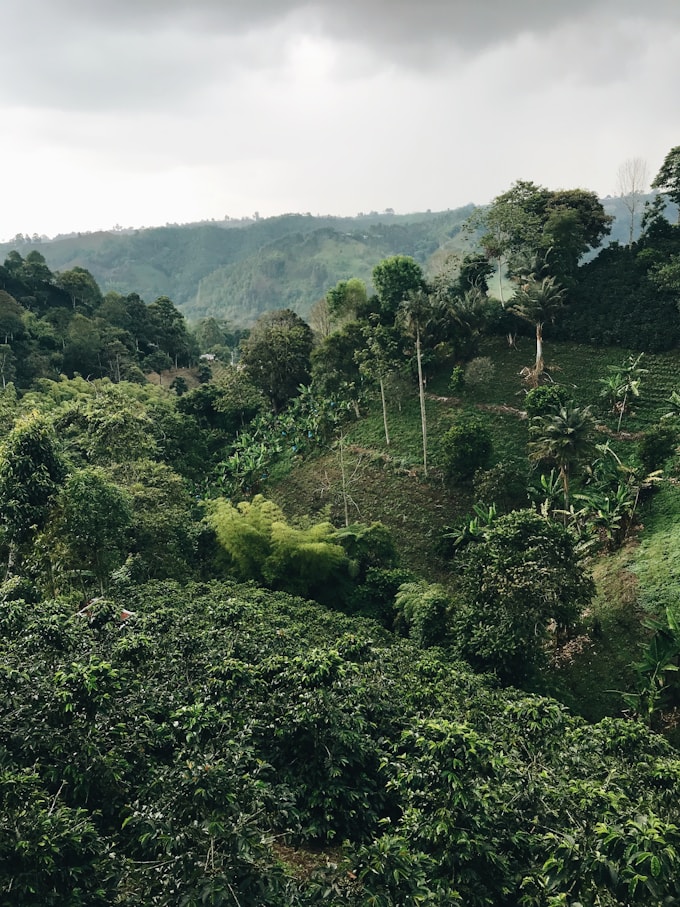
Huila is in the southwestern Andes, squeezed between two mountain ranges — the Cordillera Central and the Cordillera Oriental — in a landscape that looks like it was designed by someone who wanted to make the concept of altitude as dramatic as possible. The departmental capital, Neiva, sits in a dry, hot valley at 440 meters above sea level. Drive south for an hour and you're at 1,800 meters, looking down at clouds. Keep going and you'll find farms pushing past 2,000 meters, where the nights get genuinely cold and the coffee trees take a full year to produce a single crop.
The volcanic soil is the thing that changes everything. The Andes here sit atop a geologically active belt — there are five major volcanoes visible from the highway on a clear day — and the minerals that leach into the soil give the coffee an acidity that is almost architectural in its precision. Not sharp, not aggressive. Bright. Structured. The kind of acidity that organises a cup the way a good editor organises a sentence.
I visited Acevedo two seasons ago, in March, when the harvest was just finishing. Diego Rosas's farm sits at 1,750 meters and has the slightly vertiginous quality of all high-altitude Colombian farmland — the rows of coffee trees following the contour of the slope at angles that make you grateful for the walking stick his wife handed me at the gate. Someone described the landscape to me once as Tuscany tilted sideways. That is exactly right.
"My grandmother planted roses between the rows. I still do not know if it helps the coffee, but it helps me."
— Diego Rosas, Acevedo, Huila
The roses are an early-warning system for pests and disease — they show symptoms before coffee trees do, giving the farmer time to respond. Diego's grandmother taught him this. Whether it works as well as he believes is almost beside the point. The farm smells of both flowers and coffee at harvest time, and that combination is something I find myself thinking about when I cup the lot back in Savannah.
The La Palma Washed we carry — Lot CL-25-COL-07 — is Diego's third-generation fruit, washed using traditional mucilage removal and dried on raised beds under shade cloth. The slower drying deepens the complexity. What ends up in the cup is brown sugar on the nose, a bright citrus note mid-palate, and a long almond finish that stays through the cool of the mug.
It is, for reasons I cannot entirely explain, the coffee that seems to suit Savannah's weather best. Something about the humidity here makes the cup open up differently. We think about Diego's roses every time we pour it.